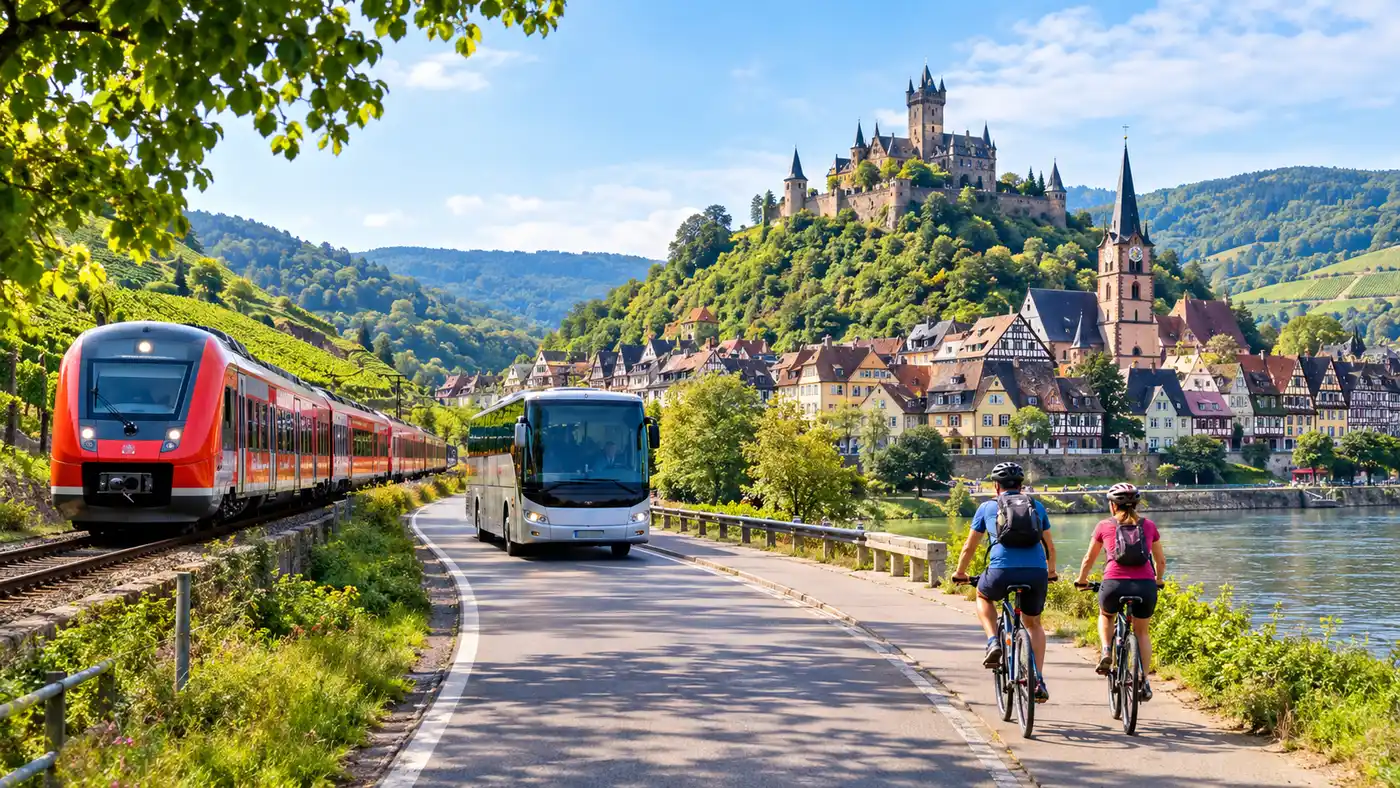
Traveling the Romantic Road by Train, Bus, and Bike
Most guidebooks assume you have a rental car waiting at the airport, keys jingling in hand. They paint a picture of effortless driving through Bavarian meadows, pulling off the highway whenever a timbered tavern catches your eye. Experiencing the romantic road germany by train is entirely possible if you accept that German regional transit moves to its own steady rhythm. You trade highway traffic jams for quiet platform benches, local bus connections, and views of rolling wheat fields from a bicycle saddle.
Figuring out how to travel the romantic road in germany without an engine of your own requires a bit of patience. The route was dreamed up in 1950 to lure motorists back to southern Germany after the war, so the transit connections do not run on a single, continuous loop. You will switch between express regional rails, village post buses, and dedicated cycle paths. It turns a standard sightseeing route into a genuine cross-country trip where the transit days feel like part of the story.
Book your romantic road germany experience:
Can You Really Do the Romantic Road Germany by Train?
The short answer is yes, with an asterisk. The main rail backbone connects the northern anchor in Würzburg, cuts through Augsburg in the south, and terminates at Füssen right by the Alps. These legs run on regular, punctual Deutsche Bahn schedules. You can sip a lukewarm filter coffee in a quiet carriage while the train skirts past the vineyards along the Main River.
Trouble begins in the middle. The medieval jewel boxes of Dinkelsbühl, Feuchtwangen, and Nördlingen lost their direct passenger train connections decades ago. Rothenburg ob der Tauber sits at the tip of a tiny spur line, requiring a quick change at Steinach. If you rely solely on heavy rail, you end up making strange detours east toward Nuremberg or west into Baden-Württemberg just to leapfrog thirty kilometers south.
To make the route work, you need to think in mixed modes. Take trains for the long jumps, jump onto regional buses to cross the rail gaps, and rent a bicycle when you want to linger along the Tauber Valley. Our guide to the romantic road germany map and route outlines these rural breaks clearly so you can spot where the tracks run out before you buy a ticket.
| Route Segment | Transit Option | Travel Time | Logistics Reality |
|---|---|---|---|
| Würzburg to Rothenburg | Regional Train (RB/RE) | 1 hour 10 mins | One easy transfer at Steinach platform 5. |
| Rothenburg to Dinkelsbühl | Regional Bus 813 / 805 | 1 hour 25 mins | Requires matching bus timetables; rare on Sundays. |
| Dinkelsbühl to Nördlingen | Bus 501 | 45 mins | Direct rural bus; scenic ride through crater rim. |
| Nördlingen to Donauwörth | Regional Train (RB) | 32 mins | Direct run; connects right to Augsburg trunk line. |
| Augsburg to Füssen | Direct Regional Train (BRB) | 2 hours | Scenic diesel rail through Allgäu alpine foothills. |
Deutsche Bahn regional tickets make this patchwork affordable. Instead of paying full fare point to point, you can stitch together regional networks using cheap day passes.
- Deutschland-Ticket: €49 per month subscription on local transit; covers regional trains, city trams, and almost every rural bus on this corridor.
- Bayern-Ticket: €29 for a solo traveler plus €10 for each extra passenger; gives unlimited regional train and bus travel across Bavaria after 9:00 AM on weekdays.
- Quer-durchs-Land-Ticket: Great if you slip over the state border into Baden-Württemberg near Bad Mergentheim or Creglingen.
Note: Regional buses in smaller districts around Dinkelsbühl sometimes operate on school schedules. Service drops off sharply after 3:00 PM during summer holidays and on weekends, so verify departure times at the stop the day before.
Munich to Rothenburg by Train: Breaking Down the Route
Almost everyone wants to start their journey along the romantic road germany from munich. It makes sense because the international airport brings you right into the Bavarian capital. Most travelers assume there must be an express train shooting straight up to Rothenburg. There is not.
Taking the munich to rothenburg by train route involves two or three changes, depending on your departure hour. You will board an ICE or Regional-Express north out of Munich Hauptbahnhof toward Nuremberg or Würzburg. From there, you switch to a regional feeder that drops you at Steinach, a tiny rural interchange station with little more than a vending machine and a windswept waiting room. At Steinach, you hop onto the short, two-carriage railbus that chugs into Rothenburg station across the final eleven kilometers.
The total train from munich to rothenburg trip takes around 2 hours and 40 minutes if your transfers line up tightly. Miss a five-minute window at Steinach, and you will sit on that open platform for an hour watching freight trains barrel past. It sounds tedious, but the journey has an old-fashioned rhythm that eases you into northern Franconia. Once you roll into Rothenburg station, the historic center is an easy twelve-minute stroll west through the Galgentor gate.
Pro tip: On the Munich to Steinach run, sit on the left side of the carriage facing forward. You get beautiful views of the Franconian hills and small farming hamlets as you approach the Tauber region.
Navigating the Gaps: Bus Romantic Road Germany Options
Years ago, a dedicated long-distance coach called the Europabus ran up and down the route daily. Backpackers could board in Frankfurt and step off in Füssen without touching a schedule. That service has been scaled back, renamed, and shifted around between private tour vendors, leaving independent travelers to lean on local public transit.
Relying on the bus romantic road germany network means getting cozy with the regional transport associations: VGN around Nuremberg and Rothenburg, and VGI further south. The buses are clean, quiet, and driven by locals who know every twist in the country roads. They stop right outside village walls rather than out by distant highway junctions.
The trickiest gap is Rothenburg to Dinkelsbühl. The train track between them has been out of passenger service for decades. You catch bus 813 from Rothenburg’s main station to Dombühl, then switch to bus 805 down to Dinkelsbühl. The drivers do not take cards for individual tickets, so keep coins or small euro bills in your pocket if you are not traveling on a pre-loaded transit pass. If you want to know which stops are actually worth the transfer hassle, check our write-up on the best towns and stops along Germany's romantic road before locking in your bus days.
Luggage can be awkward on these rural coaches. These are standard commuter buses, not highway touring coaches with deep undercarriage storage. You will be hauling your roller bag up narrow steps and wedging it into the wheelchair bay. Pack light. A forty-liter backpack turns these rural transfers from stressful scrambles into easy hops.
Book your romantic road germany experience:
Romantic Road Germany Cycling and Bike Touring
If you want the purest, most rewarding way to see this landscape, do it on two wheels. Romantic road germany cycling follows the D-Route 9, a signposted trail running roughly 460 kilometers from the Prince-Bishop’s palace in Würzburg straight to Neuschwanstein. The path pulls away from the car-choked roads, guiding you through river valleys, sunlit orchards, and silent pine forests.
The northern half along the Tauber Valley is remarkably gentle. You pedal along flat, paved riverbanks through towns like Tauberbischofsheim and Bad Mergentheim. Wineries cling to the valley walls above you, offering cheap carafes of crisp Silvaner wine at family-run seasonal taverns called Heckenwirtschaften. After Rothenburg, the terrain rolls through the Franconian Heights. You will sweat on the climbs up to small ridge villages, but the descents through sweeping wheat plains make up for it.
Combining bikes with trains is standard practice in Bavaria. You can cycle hard for two days, tire yourself out on the hills near Nördlingen, and wheel your bike right onto a regional train carriage to bypass the flat industrial outskirts of Augsburg.
- Bike tickets: You must purchase a Fahrrad-Tageskarte Bayern (around €6.50) to bring a bicycle on regional trains.
- Space availability: Look for the large bicycle symbol printed on the outside of train doors; these carriages have folding seats with straps to secure your frame.
- E-bike charging: Many town squares, including Dinkelsbühl and Donauwörth, now offer free lockable charging stations near their tourist offices.
- Bike rentals: One-way touring rentals are tough to arrange locally; rent from a larger outfitter in Würzburg or Munich who allows drop-offs across state lines.
Walking the romantic road germany is another route entirely. The long-distance hiking trail follows the same valley routes on dirt tracks and forest ways. It takes nearly four weeks to complete on foot. Most people pick a three-day slice, like the section between Würzburg and Rothenburg, sending their heavy luggage ahead via local taxi services while walking through vineyards with a daypack.
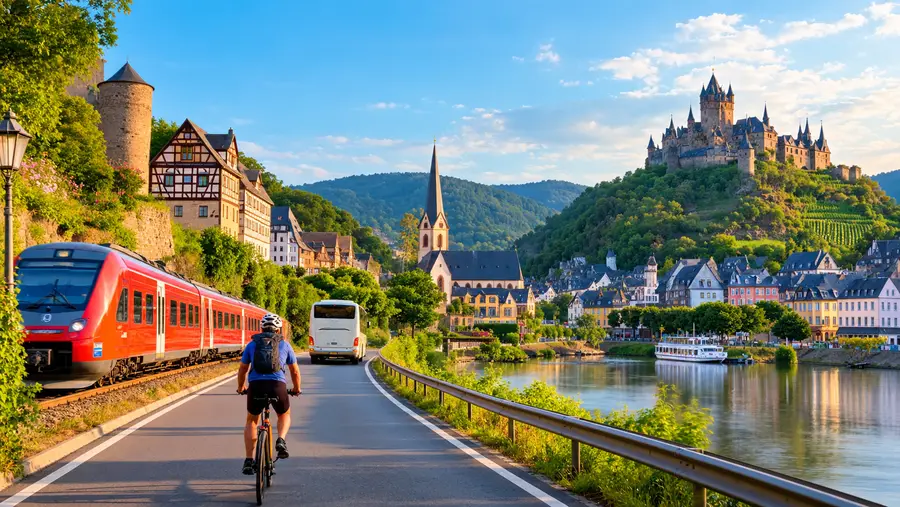
Combining Train, Bus, and Foot: A Practical Sample Itinerary
You do not have to commit to just one vehicle. A four-day mixed-mode trip gives you the best parts of the route without the exhaustion of pedaling 400 kilometers with panniers. Our detailed breakdown of the romantic road germany itinerary covers multi-day schedules in depth, but this rail-and-bus combo is specifically tailored to public transit timings.
Start your first morning in Würzburg. Walk up to the Marienberg Fortress on foot, take in the river views, and eat a quick bratwurst on the old bridge. After lunch, hop the regional train to Rothenburg via Steinach. You arrive in time to wander the cobblestones after the big tour coaches leave for the evening.
Spend day two taking the morning bus south toward Dinkelsbühl. The medieval walls here are completely intact, with twenty surviving towers you can inspect from the ground. Have a plate of roast pork shoulder at a guesthouse on the Weinmarkt, then take the late afternoon bus down to Nördlingen. Sleep inside the impact crater where Nördlingen sits, climbing the tower of St. George's Church before breakfast on day three.
From Nördlingen, the train returns to your service. Take the local connection south to Donauwörth, switch over to Augsburg, and spend a few hours touring the Fuggerei, the oldest social housing project in the world. Late that afternoon, board the diesel train that snakes past the alpine lakes into Füssen. You wake up on day four under the shadow of the mountains, boarding the local transit bus up to the ticket center at Hohenschwangau Castle with your return train to Munich already mapped out for the evening.
Frequently Asked Questions about romantic road germany by train
Can you travel the entire Romantic Road using only trains?
No, because the middle section between Rothenburg ob der Tauber, Dinkelsbühl, and Nördlingen lacks continuous passenger rail service. You must use local buses to cover roughly fifty kilometers of that gap, or make wide train detours through larger cities far to the east.
Is the Deutschland-Ticket valid on all trains along the Romantic Road?
Yes, it covers every regional train (RB, RE, and private regional lines like BRB) as well as the local transit buses between the towns. It does not cover high-speed ICE or IC trains, so you must uncheck fast trains on the Deutsche Bahn app when searching routes.
How do you get to Neuschwanstein Castle from Füssen train station?
Local buses 73 and 78 depart directly from the bus bays outside Füssen station every fifteen to twenty minutes, dropping you at the Hohenschwangau ticket center in around ten minutes. The ride is included if you carry a valid Bayern-Ticket or Deutschland-Ticket.
Quick Reference
- Primary hubs: Würzburg, Augsburg, and Füssen have direct train lines
- Middle connection: Rothenburg to Dinkelsbühl requires local buses 813 and 805
- Best pass: Bayern-Ticket covers rail and buses across Bavaria after 9:00 AM
- Cycle route: D-Route 9 spans 460 km along dedicated, paved paths
- Munich link: Munich to Rothenburg takes roughly 2.5 hours with 2 train transfers
Book your romantic road germany experience:
My Take
Ditching the car on the Romantic Road forces you to slow down in the best possible way. You will spend quiet mornings waiting at small-town rail stops, watching station cats stretch in the gravel while church bells ring in the distance. Pack a good book, keep an offline bus schedule saved on your phone, and let the rail network dictate your pace. It turns an ordinary Bavarian drive into an actual journey across the countryside.
Read more about romantic road germany.