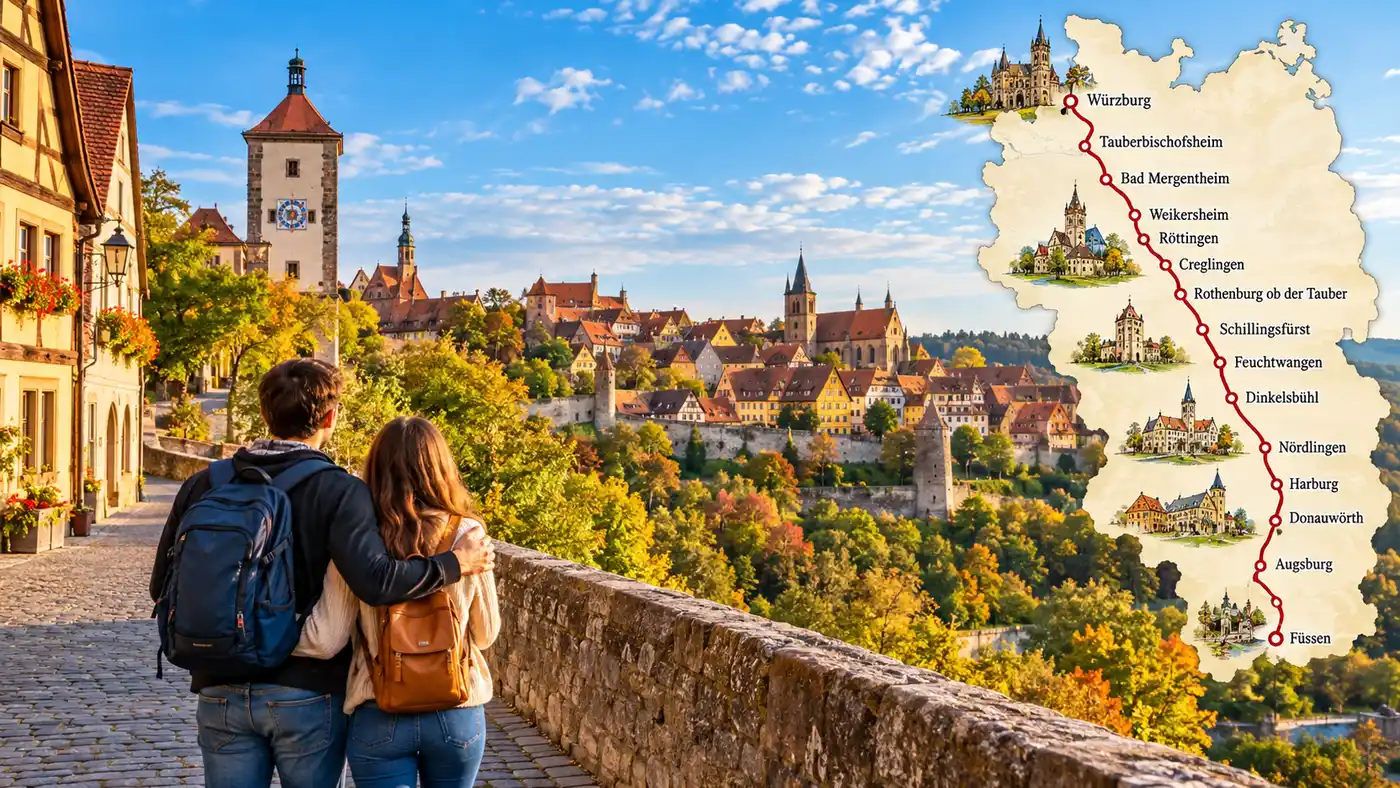
Romantic Road Germany Map and Route Guide
When you sit down with a romantic road germany map for the first time, you realize pretty quickly that it is not a straight shot or a high-speed motorway. It winds. It doubles back around bends in the Tauber River, cuts across rolling farmland in middle Franconia, and slips into tiny walled villages where your rental car barely squeezes past timber-framed bakery corners. It covers roughly 460 kilometers from the wine cellars of Franconia down to the jagged foot of the Bavarian Alps.
I learned the hard way that blindly following Google Maps will ruin this drive. Navigation apps want to push you onto the Autobahn to save seven minutes. Doing that bypasses the quiet country roads that make the trip worthwhile in the first place. You need a solid romantic road germany route map in your head before turning the key, knowing when to follow the signs and when to deliberately ignore the fastest GPS calculation.
Book your romantic road germany experience:
Understanding the Romantic Road Germany Route from North to South
People always ask where does the romantic road start in germany. The route begins in Würzburg, a lively university city tucked into northern Bavaria, famous for its baroque Residenz palace and dry Silvaner wine poured on the old bridge. From there, it threads south through the Tauber Valley, passes through Rothenburg ob der Tauber, cuts across an ancient meteorite crater at Nördlingen, rolls into Roman-founded Augsburg, and finishes against the Austrian border in Füssen.
So where does the romantic road in germany start and end? It is 460 kilometers of tarmac stretching between the prince-bishop's palace in Würzburg and the castle-crowned crags of Füssen. The route was cobbled together back in 1950 by tourism officials looking to revive travel in post-war West Germany. They tied together old trade corridors, Roman military roads, and sleepy medieval market towns into one cohesive holiday corridor.
If you look at a romantic road bavaria map, you will see the path crosses three distinct cultural zones. You start in Franconia, where wine bottles come in squat, rounded flasks called Bocksbeutel and the architecture leans heavy on exposed half-timbering. Then you enter Swabia around the Ries crater, where spätzle shows up on every dinner plate. Finally you hit Upper Bavaria and the Allgäu, where onion-domed churches give way to dairy pastures and snow-dusted alpine walls.
How long is the romantic road in germany if you drive it without stopping? Technically about seven hours. Doing it in a single day is a miserable mistake, though. You spend your whole day trapped behind tractors and milk delivery trucks without stepping inside a single castle gate. Give it four or five days minimum, or pick one section to savor properly.
Note: German road signs use the local term Romantische Straße accompanied by a small brown crest, but local bypass roads occasionally drop the signage for several kilometers. Keep an eye on local highway numbers rather than relying solely on visual logo markers.
Key Stages on the Romantic Road Map
Breaking down a map of romantic road stops into three distinct legs makes planning simple. You can easily tailor your pace depending on whether you love medieval battlements, quiet village squares, or mountain views.
| Route Segment | Distance | Driving Time | Primary Roads | Key Highlights |
|---|---|---|---|---|
| Würzburg to Rothenburg | 98 km | 1 hr 45 min | B19, B290, L2251 | Würzburg Residenz, Weikersheim Palace, Tauber Valley |
| Rothenburg to Nördlingen | 82 km | 1 hr 15 min | B25 | Rothenburg ramparts, Dinkelsbühl, Baldern Castle |
| Nördlingen to Augsburg | 74 km | 1 hr 10 min | B25, B2 | Ries meteorite crater, Harburg Castle, Fuggerei |
| Augsburg to Füssen | 106 km | 1 hr 35 min | B17 | Landsberg am Lech, Wieskirche, Neuschwanstein |
The first leg, running from Würzburg through the Tauber Valley, is all about rolling vineyards, quiet villages, and sleepy castle gardens. Weikersheim is an underappreciated gem here. Most tour buses bypass it entirely to rush toward Rothenburg, leaving its magnificent Renaissance palace and manicured garden terraces blissfully empty. I spent two hours wandering between the limestone dwarf statues in the garden without hearing another English speaker.
The middle stretch delivers the storybook medieval core everyone pictures when searching for a romantic route map. Rothenburg ob der Tauber, Dinkelsbühl, and Nördlingen form a trio of remarkably preserved walled towns. Nördlingen is my personal favorite of the bunch. It sits directly inside a massive crater formed by a meteorite 15 million years ago, and you can walk its complete circular rampart without paying an entry fee.
The southern stretch shifts character completely. As you pass Landsberg am Lech and cross toward Steingaden, the landscape tilts upward. Flat crop fields turn into lush green cow pastures, wooden barns replace stone townhouses, and the sharp jagged skyline of the Alps rises up in front of your windshield like a granite wall.
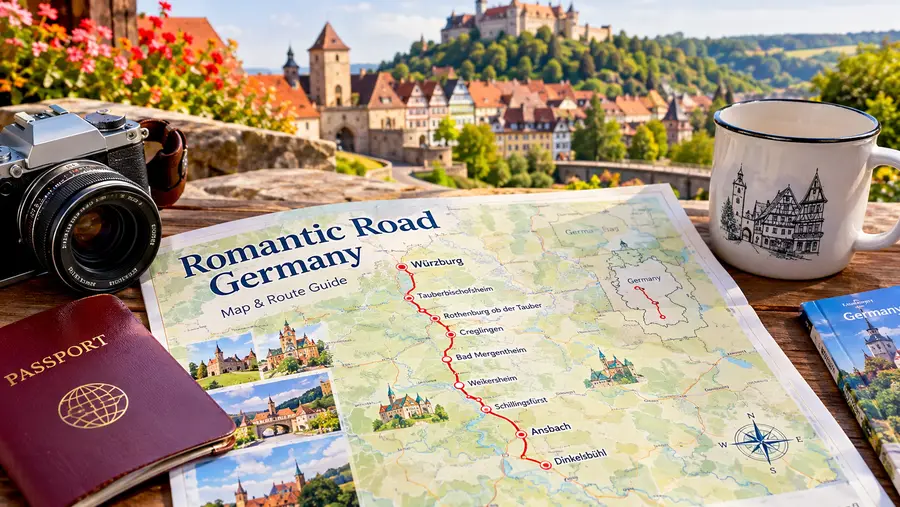
Navigating the Romantic Highway Germany Map: What Roads to Take
A frequent question is what highway is the romantic road in germany. It is not actually an Autobahn. It is not even a single federal road. The route is a stitched-together sequence of federal highways (marked with a 'B' for Bundesstraße) and secondary state roads (marked with an 'L' or 'St').
In the north, you spend considerable time following the B19 and B290 through the Tauber Valley before picking up rural secondary roads near Creglingen. Once you hit Rothenburg, the spine of the journey relies heavily on the B25 running down through Dinkelsbühl and Nördlingen to Donauwörth. South of Donauwörth, you merge onto the four-lane B2 down to Augsburg, then take the B17 straight south toward the mountains. If you are planning on driving the Romantic Road in Germany, you must accept that speed limits will constantly bounce between 100 km/h on open stretches and 50 km/h inside municipal borders.
Because the route is not a dedicated single-number highway, navigating without a plan can get tricky. Keep these core navigation tips in mind when consulting your map of germany romantic road travel:
- Watch for brown route signs: Brown roadside boards marked with Romantische Straße mark key intersections, but they face away from you if you miss a turn, so treat them as confirmation rather than your primary guide.
- Disable highway preference in your GPS: Set your navigation unit to avoid motorways (Autobahnen) if you want to experience the authentic scenic ribbon rather than fast bypass lanes.
- Watch out for sudden detours: German roadwork signs reading Umleitung send drivers on sprawling detours through side valleys that can add 30 minutes to a short leg.
- Pay attention to town boundary signs: The yellow rectangular sign bearing a town name functions as an absolute 50 km/h speed zone trigger, and hidden speed cameras are very common directly past these signs.
Pro tip: Download offline maps for your entire route onto your smartphone before leaving home. Cell coverage can drop out unexpectedly while driving through the deep forested hollows of the Tauber Valley and the Ammergau hills.
Parking inside the fortified towns demands a strategy too. Every medieval town on your romantic strasse map features historic centers paved with rough river cobbles where cars are either forbidden or severely restricted. Almost every stop provides designated ring parking lots right outside the stone gates, clearly labeled P1, P2, and so forth. Expect to pay about 4 to 8 euros for a full afternoon of parking.
Book your romantic road germany experience:
Best Base Towns Along Germany's Romantic Road Map
Trying to pack your bags and check into a different guesthouse every single night gets exhausting by day three. A much smarter way to tackle a romantic road germany map with cities is setting up two or three strategic base camps and doing short loop trips.
When selecting your overnight hubs, consider towns that combine good restaurant options with easy road access so you do not spend 20 minutes threading through gate arches every morning:
- Würzburg: Perfect for your initial northern base, offering great riverfront wine bars, baroque architecture, and direct rail connections from Frankfurt Airport.
- Dinkelsbühl: A quieter, more authentic alternative to Rothenburg ob der Tauber for an overnight stay, with colorful burgher houses and fewer day-trip bus crowds.
- Augsburg: Great central hub for city amenities, excellent Swabian dining, and fascinating Renaissance history at the Fuggerei social housing complex.
- Füssen: The logical southern terminus, letting you reach King Ludwig's castles before the massive Munich tour groups pull in at mid-morning.
Rothenburg is enchanting after dark once the tour groups clear out around 5:00 PM, but hotel prices inside the walls carry a heavy premium. Dinkelsbühl gives you almost the exact same medieval atmosphere, complete with moat reflections and night watchman tours, without the high costs. If you want to dive deeper into village choices, read up on our guide to the best towns along Germany's Romantic Road.
Landsberg am Lech is another overlooked base. Sitting about halfway between Augsburg and the Alps, it features a pastel town square and a roaring tiered waterfall along the Lech river. Finding a table for dinner there is simple, and parking outside the gates is cheap.
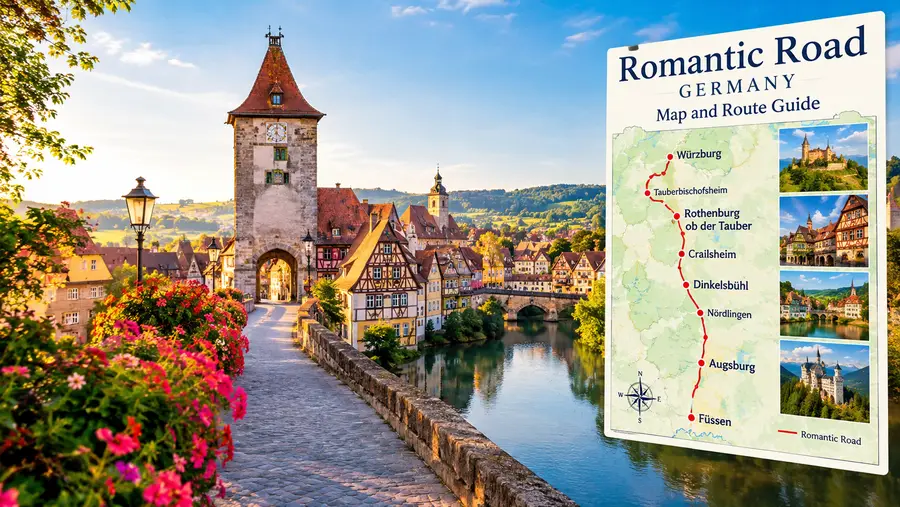
Mapping Scenic Detours Worth the Extra Miles
A standard printable map of romantic road germany sticks straight to the historic spine, but a few of the most memorable stops require taking a quick branch off the official path. These detours reveal a quieter side of southern Germany that tour buses never see.
My top side trip recommendation is Harburg Castle. Perched high on a rocky bluff over the Wörnitz River, Harburg is one of the oldest, best-preserved fortresses in southern Germany. Unlike Neuschwanstein, which was built as a theatrical palace in the 1800s, Harburg was an authentic military fortress with battlements, dungeons, and thick defensive towers dating back to the 11th century. It sits just off the B25 between Nördlingen and Donauwörth, yet people routinely speed past its access turnoff without looking up.
Another essential detour sits right near the southern terminus: the Wieskirche. Tucked away in an open farm meadow near Steingaden, this modest, yellow-and-white church looks plain from the outside road. Step inside, and you are hit with a mind-boggling explosion of Bavarian rococo stucco, gilded carvings, and ceiling frescoes painted in 1754 by the Zimmermann brothers. Entrance is free, though dropping a 2-euro coin in the collection box helps maintain the historic plasterwork.
If you have an extra half day near Würzburg, track the Main River eastward toward the village of Sommerhausen. It is walled, surrounded by terraced vineyards, and home to small independent ceramic studios and cellar pubs that feel completely disconnected from modern rush.
Frequently Asked Questions about romantic road germany map
What is the total driving distance of the Romantic Road?
The classic route covers roughly 460 kilometers (about 285 miles) from Würzburg in the north down to Füssen in the Bavarian Alps. With minor scenic detours and visits to hillside castles, most travelers log closer to 520 kilometers.
Can you travel the Romantic Road without a rental car?
Yes, though it requires patience. You can link many stops using regional trains run by Deutsche Bahn, especially Würzburg, Rothenburg (via Steinach), Augsburg, and Füssen. However, smaller villages like Dinkelsbühl lack direct train stations and require regional buses.
How many days do you need to follow the route map?
Four to five days is the sweet spot for driving the full route without feeling rushed. This allows you enough time to explore two towns per day, tour castles, and take relaxed dinners without long hours behind the wheel.
Quick Reference
- Route distance: 460 km (285 miles)
- Start point: Würzburg, Franconia
- End point: Füssen, Allgäu Alps
- Key route roads: B19, B25, B2, B17
- Ideal trip duration: 4 to 6 days
Book your romantic road germany experience:
Before You Hit the Road
Get yourself a good paper map or cache your digital maps before you start the engine in Würzburg. Take your time along the country backroads, stop for hot plum cake in quiet town squares, and do not be afraid to pull off the designated trail whenever an interesting stone gate or castle ruin catches your eye along the valley ridge.
Read more about romantic road germany.