Best Towns and Stops Along Germany's Romantic Road
Most people rush the drive. They pick up a rental car at Frankfurt airport, plug Neuschwanstein into the navigation screen, and blast down the Autobahn at 160 kilometers an hour without realizing they bypassed 28 historic villages hidden behind limestone ridges and Franconian vineyards. If you want the real trip, you need to slow down and wander through the best towns on romantic road germany has tucked away between Würzburg and the Bavarian Alps. You will smell woodsmoke, stale cellar beer, and damp wall plaster from the fourteenth century.
The entire route spans about 460 kilometers. It connects ancient trade hubs, fortified walled settlements, baroque palaces, and quiet farming communities where cows still wander across rural two-lane roads. Some villages take two hours to see. Others deserve two full nights, especially when the day-tripper buses leave at four in the afternoon and the cobblestones fall silent. Here is an honest look at where to stop, what to skip, and how to navigate the absolute best towns on the romantic road germany offers along the way.
Book your romantic road germany experience:
Würzburg and the Tauber Valley: Starting Up North
Würzburg gives you an immediate punch of Bavarian confidence. The city was leveled in twenty minutes during an air raid in March 1945, but looking at the rebuilt baroque facades today, you would barely know it. The Residenz palace sits squarely in the town center. Its ceiling fresco by Giovanni Battista Tiepolo is enormous, painted across a self-supporting vault that defied eighteenth-century engineers. Honestly, standing underneath that vaulted ceiling makes your neck ache, but the sheer scale of the plasterwork is worth twenty minutes of your morning.
Walk straight from the palace to the Alte Mainbrücke. Locals gather on this sandstone bridge around noon to drink Franconian Silvaner wine poured into distinct rounded bottles called Bocksbeutel. You pay a five-euro glass deposit, lean against the stone parapet, and look up at the Marienberg Fortress perched across the river. It feels alive and unpretentious.
Heading south into the Tauber Valley, the traffic thins out quickly. You enter Tauberbischofsheim and then Bad Mergentheim, where the Teutonic Order kept their headquarters for nearly three centuries. These are among the quietest towns on romantic road germany preserves, largely overlooked by overseas tourists who are in a frantic hurry to reach the castles. Bad Mergentheim has a surprisingly grand palace square, quiet medicinal gardens, and bakery windows stacked with plum tarts.
- Alte Mainbrücke wine stand: open daily around 10:00 AM, €6 to €8 per pour, deposit returned in cash.
- Residenz courtyard gardens: free entry, open until dusk, gorgeous shaded paths for an afternoon walk.
- Weikersheim Palace detour: 15 minutes south of Bad Mergentheim, famous for its intact 1600s Knight's Hall and manicured orangery.
Rothenburg and Dinkelsbühl: The Walled Legends
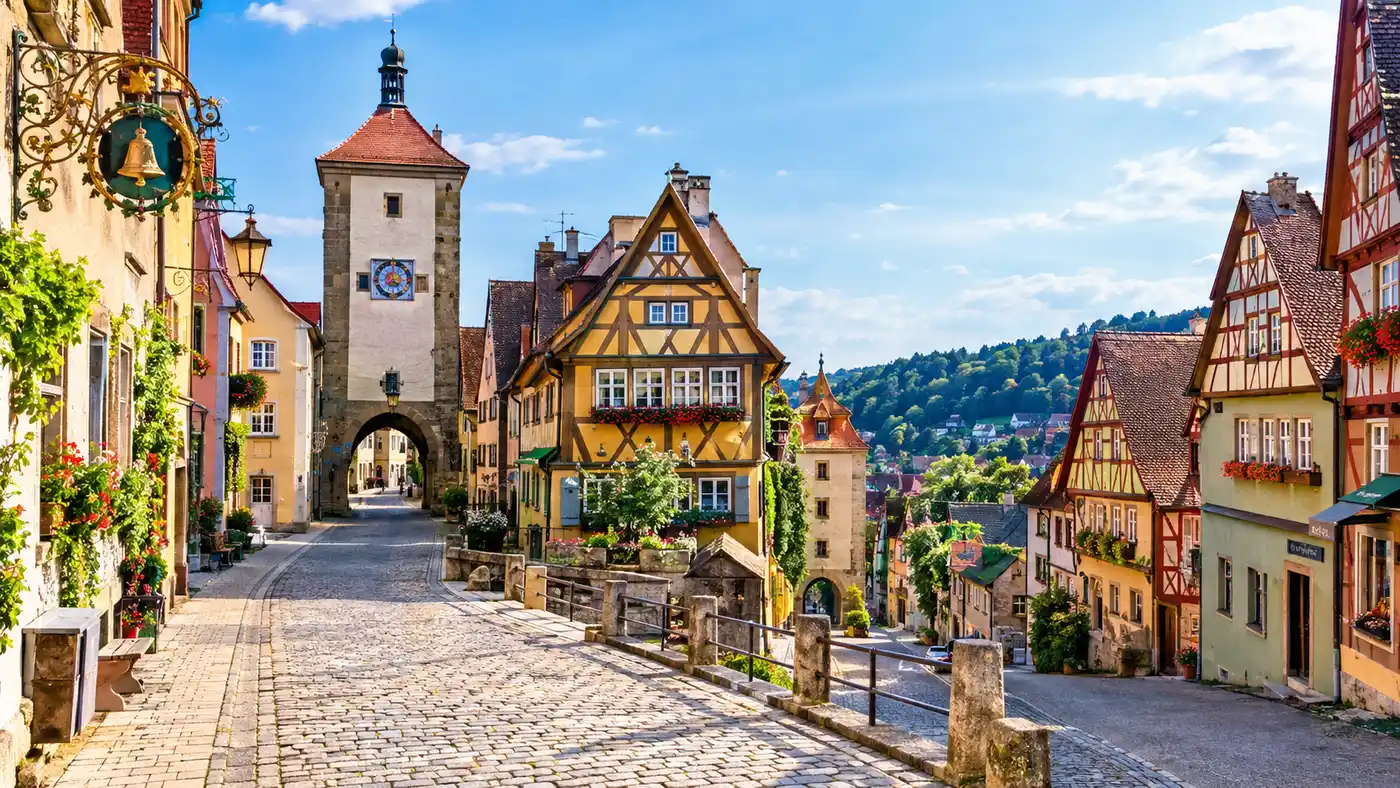
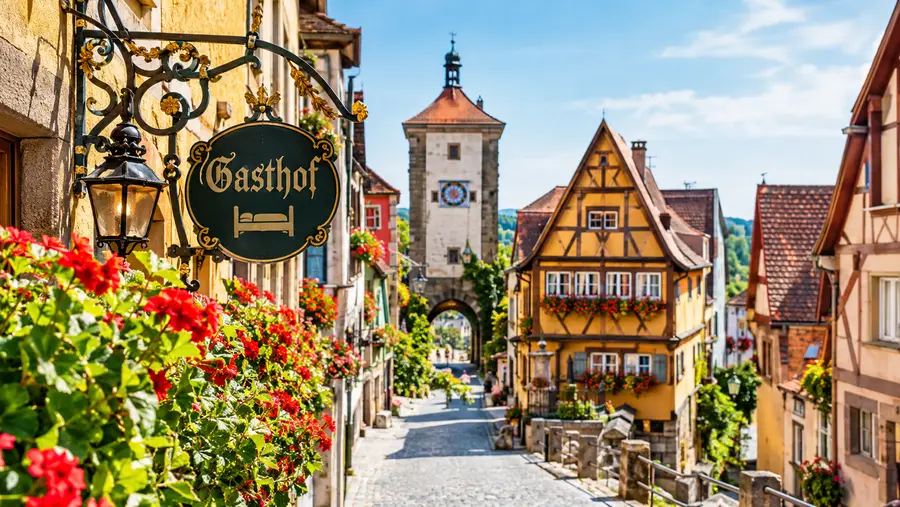
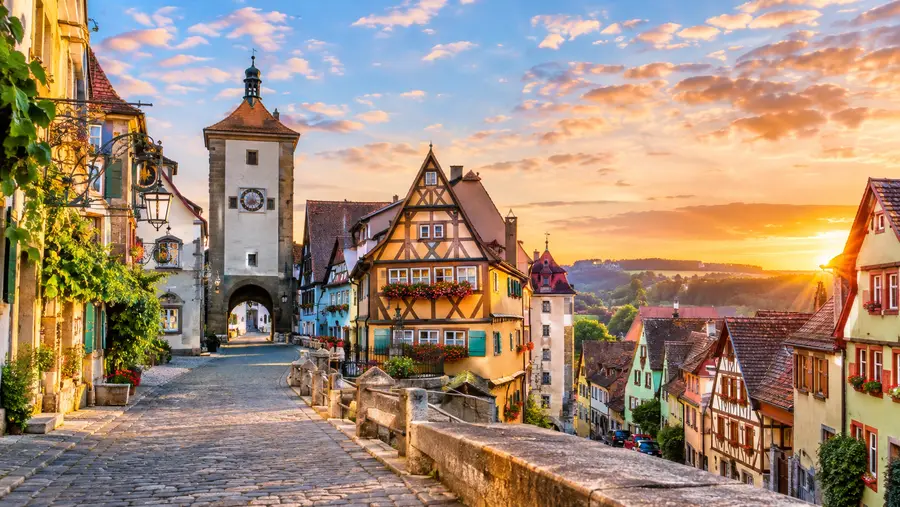
Rothenburg ob der Tauber is ridiculously famous, and it earned every bit of that reputation. Yes, it gets packed. By midday, tour groups choke the alley leading down to the Plönlein fork, snapping identical photos of the yellow timbered house and the twin gate towers. But if you spend the night inside the ramparts, Rothenburg changes completely. Morning mist clings to the Tauber river valley below, bakery shutters rattle open at seven, and you can walk three uninterrupted kilometers along the covered defensive wall without bumping shoulders with anyone.
The town escaped destruction during the Thirty Years' War and was largely spared from heavy artillery in 1945 due to an American assistant secretary of war who remembered his mother's stories about its beauty. That preserved medieval perimeter gives Rothenburg germany romantic road bragging rights that few places on earth can challenge. Skip the touristy snowball pastries, which taste mostly of dry shortcrust and powdered sugar, and grab a crusty rye roll with liver sausage from a local butcher instead.
Pro tip: Walk the eastern section of Rothenburg's town wall just after sunrise. The low sun hits the terracotta roof tiles at an angle that makes early morning romantic road germany pictures look incredible, without a single tourist head in the frame.
Forty-five minutes south sits Dinkelsbühl, often misspelled as dinklesbuhl in hurried vacation notes. If Rothenburg feels like an open-air stage set, Dinkelsbühl feels like an actual working town. It has sixteen fortified towers, four gates, and a moat full of carp. The central minster of St. George is an unvarnished late-Gothic hall church with uneven stone floors and no modern pews to ruin the sightlines. Many travelers consider it one of the absolute best places to visit romantic road germany contains simply because it lacks the heavy commercial gloss of its northern neighbor.
Comparing the Best Towns on Romantic Road Germany
Picking which stops deserve an overnight stay versus a quick coffee break depends on your driving pace. The road twists through Franconia into Swabia and Upper Bavaria, with wildly shifting regional accents, architecture, and kitchen specialties. If you are driving the Romantic Road on a tight schedule, this comparison breaks down the main contenders.
| Town | Region | Main Draw | Time Needed | Crowd Level |
|---|---|---|---|---|
| Würzburg | Lower Franconia | Residenz & Wine Culture | 1 Full Day | Moderate |
| Rothenburg | Middle Franconia | Intact Defensive Ramparts | 1 to 2 Days | Heavy |
| Dinkelsbühl | Middle Franconia | Gothic Alleys & Quiet Moat | Half Day | Low to Mid |
| Nördlingen | Swabia | Meteorite Crater Wall | 3 to 4 Hours | Low |
| Augsburg | Swabia | Renaissance Palaces & Fuggerei | 1 Full Day | Moderate |
| Landsberg am Lech | Upper Bavaria | River Weir & Pastel Square | 2 to 3 Hours | Low |
| Füssen | Allgäu / Swabia | Mountain Lakes & Neuschwanstein | 1 to 2 Days | Very Heavy |
These germany romantic road towns show how varied the route is. You transition from wine country to beer halls in less than two hours. Rothenburg and Dinkelsbühl capture the medieval romantic road germany highlights, but skipping the geological weirdness further south would be a mistake.
Book your romantic road germany experience:
Nördlingen and Augsburg: Meteorites and Merchant Dynasties
Nördlingen sits inside the Ries crater, an ancient basin created by a meteorite impact fifteen million years ago. The stone used to build St. George's church contains millions of microscopic diamonds formed by the blast pressure. How cool is that? Even better, Nördlingen is the only town in Germany with a completely closed, walkable wall that features an intact covered battle walkway running its full perimeter. You can complete the circle in about an hour, looking down into private vegetable gardens, backyard chicken coops, and old timbered barns.
Climb the Daniel tower at the town center. The watchman up there still calls out "So, G'sell, so!" every thirty minutes between ten at night and midnight, a ritual dating back to 1440 to make sure the town guards stayed awake. From the top platform, the circular rim of the crater is clearly visible on the horizon, ringed by distant green hills.
Note: Climbing the 350 steps of the Daniel church tower costs €4 in cash at the top platform. The wooden stairs get very narrow near the belfry, so leave bulky daypacks in your car trunk.
Leaving Nördlingen, you pass Harburg Castle, a massive defensive complex that looks down on the Wörnitz river. It is among the most impressive medieval castles on the Romantic Road, well worth an hour to stretch your legs on the gravel paths. Beyond Harburg lies Augsburg, one of Germany's oldest cities. Founded by the Romans under Emperor Augustus, it became an obscene powerhouse of European finance during the 1500s thanks to the Fugger family.
Augsburg has a different vibe entirely. Wide Renaissance streets replace crooked timber alleys. You must see the Fuggerei, the world's oldest social housing complex still in operation. The annual rent has remained one Rhenish guilder (roughly €0.88 today) since 1521, along with three daily prayers for the founder's soul. It feels like a quiet walled village tucked directly inside a modern, bustling urban center.
Landsberg am Lech to Füssen: Approaching the Alps
Past Augsburg, the terrain changes fast. The flat plains crumple into rolling green dairy pastures dotted with brown Allgäu cows. Landsberg am Lech is an absolute gem that many drivers skip completely. The town sits right along the turquoise Lech river, where a broad four-tiered weir rushes noisily through the center. The town square is painted in butter-yellow, mint, and peach hues, filled with Italian espresso bars and outdoor ice cream shops on sunny afternoons. It feels half-Bavarian, half-Mediterranean.
Further south, the route enters the Pfaffenwinkel, which translates roughly to "Priest's Corner." Monasteries and pilgrimage churches pop up every few kilometers. The Wieskirche stands in the middle of an open field near Steingaden. From the gravel parking lot, it looks like an ordinary country chapel. Step through the heavy oak door and you are hit by a dizzying explosion of rococo gold leaf, pastel frescoes, and carved stucco angels. It feels almost hysterical in its ornamentation, but the craftsmanship is undeniable.
The road terminates at Füssen, pressed flat against the rugged foot of the Alps. Füssen itself has a handsome late-Gothic castle, the Hohes Schloss, and narrow cobblestone paths leading down to the milky blue river. Most people stay here only to access Hohenschwangau and Neuschwanstein just down the road. Those palaces are undeniably dramatic, but spending an evening wandering Füssen's quiet monastery courtyards is far more relaxing than waiting in the ticket line at the ticket pavilion.
- Lech Weir in Landsberg: perfect spot for a quick picnic lunch with fresh bakery pretzels.
- Wieskirche timing: arrive between 8:30 AM and 9:30 AM before tour buses clog the narrow nave.
- Lake Forggensee ferry: runs June through October, giving sweeping views of the mountains rising behind Füssen.
- St. Mang's Abbey: historic Baroque library and lute-making museum right in central Füssen.
Taking in all these romantic road germany best stops takes real patience. Trying to knock out six villages in one day turns a poetic journey into an exhausting checklist. Pick two towns to sleep in, wander when the light softens, and allow yourself to get slightly turned around in back alleys that do not show up on tourist maps.
Frequently Asked Questions about best towns on romantic road germany
What are the absolute best towns on romantic road germany to visit if I only have three days?
Focus on Würzburg, Rothenburg ob der Tauber, and Füssen. That triangle gives you a grand baroque palace and wine culture up north, an intact walled medieval center in the middle, and the dramatic alpine castle scenery down south.
Is Dinkelsbühl better to visit than Rothenburg ob der Tauber?
Dinkelsbühl is quieter, feels less commercialized, and sees far fewer bus tour crowds. Rothenburg has more dramatic walls, steeper views over the Tauber valley, and more dining options. If you hate crowds, pick Dinkelsbühl. If you want theatrical medieval scale, pick Rothenburg.
Can you explore these towns on the Romantic Road without renting a car?
Yes, but train connections skip several small stops like Dinkelsbühl and the Wieskirche. Trains connect Würzburg, Augsburg, and Füssen easily. For the middle section, regional buses run between towns, though you need to check weekend schedules carefully to avoid long waits at rural transfer stations.
Quick Reference
- Route length: 460 kilometers from Würzburg to Füssen
- Best home bases: Rothenburg ob der Tauber and Landsberg am Lech
- Wall walking: Rothenburg (3 km) and Nördlingen (complete circle)
- Recommended trip length: 4 to 6 days
Book your romantic road germany experience:
The Bottom Line
The route works best when you abandon the urge to see every single stop on the official brochure. Pick three or four towns that appeal to your taste, whether that means sipping Silvaner on an arched bridge in Würzburg or hunting for meteorite impact diamonds in Nördlingen. Slow down, stay inside the old walls after sunset, and let the quiet rhythm of southern Germany set your pace.
Read more about romantic road germany.