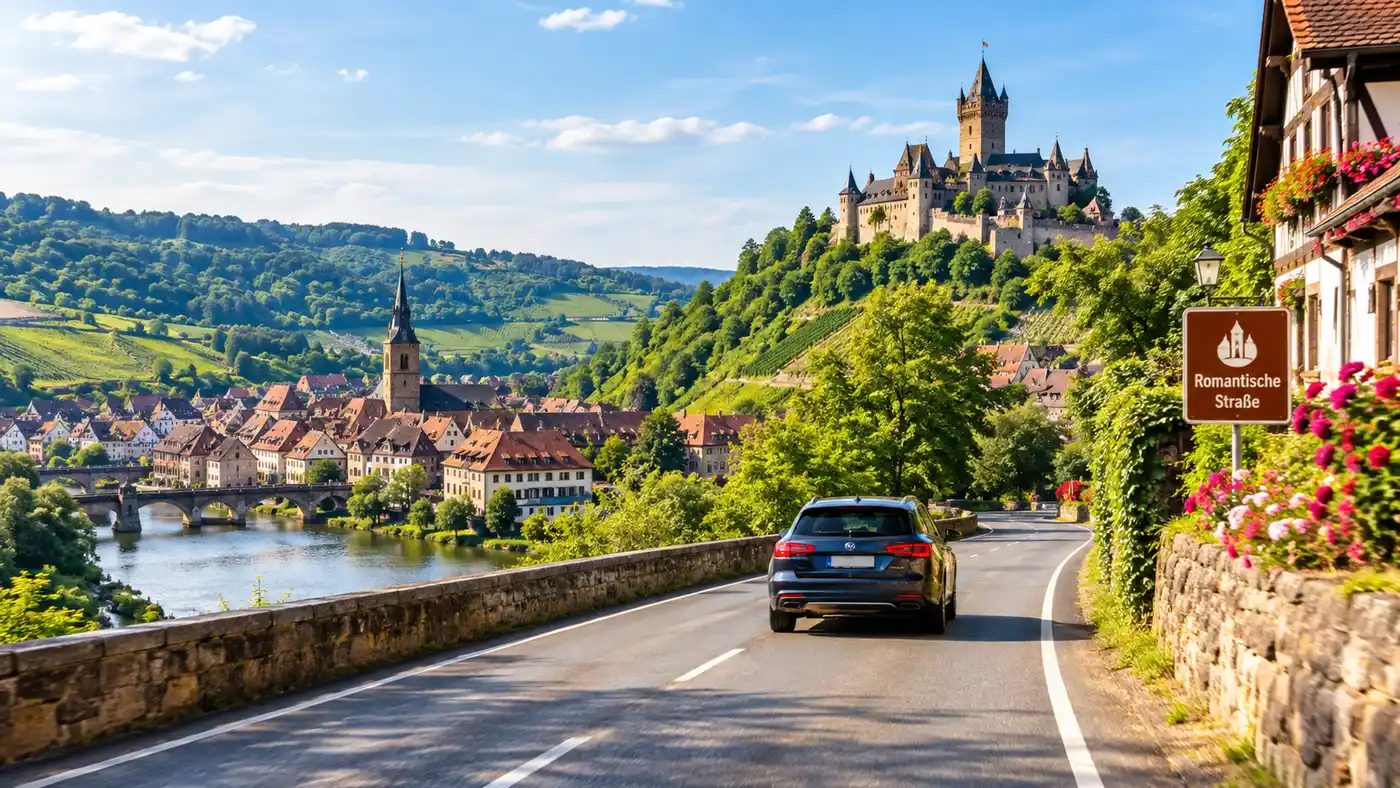
Driving the Romantic Road in Germany
Most people imagine cruising down empty, sun-dappled lanes with castle spires rising over every gentle hill. When you commit to driving the romantic road germany, the fantasy meets reality pretty fast on a two-lane Bundesstraße behind an enormous John Deere tractor hauling beets. You will smell manure, you will get stuck behind delivery trucks in tiny medieval gates, and you will love every single mile of it. The route strings together roughly 460 kilometers of Franconian wine country, walled Swabian villages, and dramatic Bavarian alpine foothills.
Having a car gives you total control over the clock. You can ditch the tour bus crowds in Rothenburg by noon, detour to a half-timbered bakery that is not in any guidebook, and reach the southern mountains just as the late afternoon light turns the pastures gold. Setting out on a romantic road germany self drive requires understanding how rural German roads actually operate. Navigating local speed traps, tight parking plazas, and regional traffic quirks takes a bit of preparation, but it is easily the best way to see this part of the country.
Book your romantic road germany experience:
The Route Reality: Romantic Road Germany Driving from North to South
The classic path runs from Würzburg in the north down to Füssen on the Austrian border. You can technically run it backward, though building toward the Alps feels more satisfying than leaving them in your rearview mirror. The route is not a single, purpose-built highway. It is a loose patchwork of federal roads, mainly the B25, B290, and B17, stitched together back in 1950 to lure American tourists and their dollars back to postwar Germany.
Follow the brown signs marked "Romantische Straße" with the three arches logo. They are everywhere, though road construction often forces you off the marked track onto unmarked farm roads. Keep an offline navigation app running on your phone because cellular reception drops completely in the wooded valleys south of Feuchtwangen. If you need a broad overview before picking your navigation markers, take a look at our Romantic Road Germany map and route guide to get your bearings on the main corridors.
Speed limits change abruptly. Out on open country roads, the default ceiling is 100 km/h, which drops the moment you pass a yellow rectangular town sign. As soon as you cross that yellow marker bearing the village name, the legal limit drops to 50 km/h instantly. No warning signs. No grace zones. If you coast past that yellow sign at 65 km/h, fixed speed cameras tucked into hedges will flash a bright red light directly into your windshield, and your car rental agency will cheerfully tack a 30-euro processing fee onto the government fine.
Pro tip: Download an offline map layer like Maps.me or Google Maps offline before leaving Würzburg, because cellular data cuts out regularly between small valley towns like Schillingsfürst and Creglingen.
Renting a Car and German Traffic Rules You Cannot Ignore
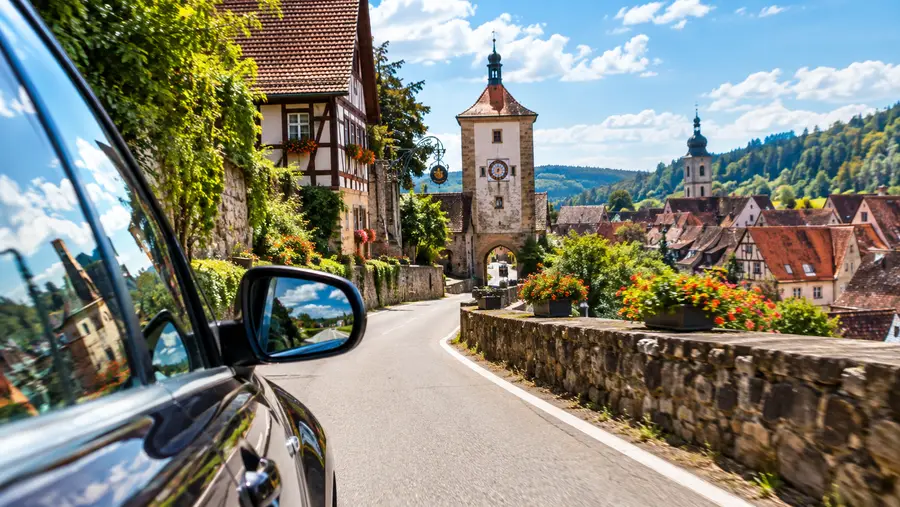
Renting a vehicle for romantic road germany driving is straightforward, but booking an automatic transmission requires reserving weeks ahead of time. Manual gearboxes remain the standard across German rental fleets. If you cannot comfortably start on a steep cobblestone incline without rolling backward, pay the extra cash for an automatic. A compact car is vastly superior to a massive SUV here. Medieval town gates like the one in Dinkelsbühl were designed for wooden oxcarts, not wide modern wheelbases.
German driving culture is disciplined and unforgiving of sloppy habits. The Autobahn does not run the length of the Romantic Road, but you will use pieces of the A7 or A3 during transit legs. Never linger in the left lane. German drivers will approach from behind at 200 km/h and flash their headlights until you move right. On two-lane country roads, yield strictly to the right at intersections without traffic lights or priority diamond signs. This rule, known as rechts vor links, applies inside almost every historic village center.
Note: Germany enforces a strict 0.05% blood alcohol limit, but if you are involved in any incident, police can penalize you at 0.03%. If you are sampling Franconian Silvaner wine or Bavarian Dunkel at lunch, designate a non-drinker or save the drinks for your hotel patio.
You also need to inspect your rental windshield for a green round sticker marked with the number 4 before driving away from the airport. This is the Umweltplakette, an emissions badge required to enter downtown low-emission zones in cities like Augsburg or Würzburg. Rental cars registered in Germany almost always have them pre-installed, but check anyway. Missing that little green circle risks an 80-euro fine if you wander into restricted city rings.
Key Driving Legs and Timing: Romantic Road Germany by Car
Trying to tackle the entire drive in two days turns a scenic escape into an exhausting marathon. You end up sitting behind steering wheels instead of wandering down ancient alleyways. Five days represents the sweet spot for a relaxed romantic road germany by car adventure, though four days can work if you skip the larger industrial stops like Augsburg.
Below is a realistic breakdown of the primary driving stretches, measuring practical driving times without factoring in stops for lunch or castle tours:
| Route Leg | Distance | Direct Drive Time | Road Character |
|---|---|---|---|
| Würzburg to Rothenburg ob der Tauber | 65 km | 50 minutes | Rolling vineyard roads, smooth state highways |
| Rothenburg to Dinkelsbühl | 45 km | 40 minutes | Rural B25, farm country, slow tractors common |
| Dinkelsbühl to Nördlingen | 32 km | 30 minutes | Flat terrain crossing the ancient meteorite crater |
| Nördlingen to Landsberg am Lech | 110 km | 1 hour 25 mins | Mix of highway bypasses and small commercial outskirts |
| Landsberg am Lech to Füssen | 85 km | 1 hour 15 mins | Ascending Bavarian foothills, open pastures, mountain vistas |
The leg between Rothenburg and Nördlingen is pure eye candy. The road slices through the Ries crater, an astronomical impact basin formed millions of years ago, giving the topography a bowl-like flatness fringed by wooded rims. Nördlingen itself sits right in the basin, built using stone embedded with microscopic diamonds caused by the ancient blast. Stopping here takes almost no extra effort since the highway runs right outside the preserved ramparts.
Farther south, the transition from Franconia into Upper Bavaria happens quickly. The houses change from exposed timber framing to broad, whitewashed farmsteads with painted murals and heavy wooden eaves. Traffic thickens dramatically as you pass Landsberg am Lech and push toward the Alps. Tourist traffic bound for Neuschwanstein pours off the A7 highway near Füssen, creating sudden bottlenecks on two-lane stretches during midday.
Book your romantic road germany experience:
Parking, Fuel, and Practical Costs for Driving Germany's Romantic Road
Fuel costs in Germany can shock North American drivers. Unleaded gasoline (Super 95 or E10) routinely hovers around 1.75 to 1.95 euros per liter, which translates to roughly 7 to 8 dollars per gallon. Avoid filling your tank at highway service plazas along the Autobahn, as they gouge drivers by 20 to 30 cents per liter compared to rural neighborhood stations like Jet, Agip, or independent village pumps.
Parking requires a firm grasp of the blue cardboard clock called a Parkscheibe. You will find this little plastic or paper dial in your rental car glove box. In many town centers, parking is free for 1 or 2 hours, but only if you set the dial to your arrival time and display it clearly on the dashboard. Forget it, and you get a ticket within 15 minutes.
- Pay-and-display meters: Most historic towns use machines marked Parkschein. Carry euro coins, because older ticket machines outside larger hubs often reject foreign credit cards or phone tap payments.
- City wall lots: Never attempt to squeeze into the historic pedestrian centers of walled towns like Rothenburg or Dinkelsbühl. Park outside the perimeter walls in designated numbered lots (P1, P2, P3) for about 6 to 12 euros per day.
- Fuel pumps: At German gas stations, pump your fuel first, memorize your pump number, and walk inside the shop to pay the cashier afterward.
- Austrian border tolls: If you wander south of Füssen toward the Austrian Tyrol, be cautious. Using Austrian highways requires a toll vignette sticker; step over the border without one and cameras catch you instantly.
Daily parking budgets along the route generally run around 10 to 18 euros if you stop in three separate towns during daytime hours. Most municipal lots charge around 1.50 to 2.50 euros per hour, capped at a modest daily maximum. Keep a stash of 1-euro and 2-euro coins inside your center console. Relying purely on Apple Pay or contactless cards will leave you stranded at unattended rural parking gates.
Scenic Detours and Beating the Crowds
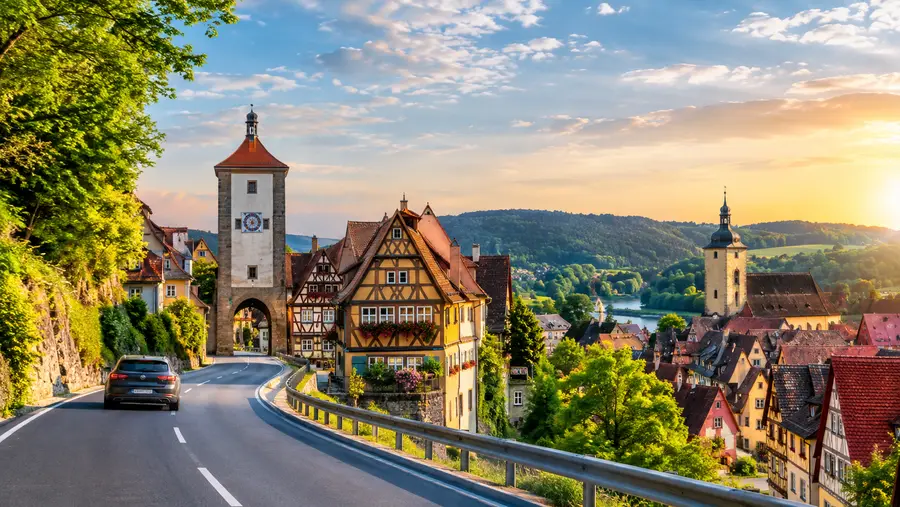
Everyone makes a beeline for the headliners: the Würzburg Residenz, Rothenburg's Plönlein corner, and Neuschwanstein Castle. If you only see those three points, your romantic road germany self drive will feel like waiting in an endless theme park queue. The magic hides in the tiny gaps between the bus stops. While mapping your overnight stops, consult our guide to the best towns along Germany's Romantic Road so you can pick quieter bases for your evenings.
For example, Tauberrettersheim sits just off the road south of Würzburg. It has a beautiful stone bridge designed by Balthasar Neumann that almost no international visitors see. You can park by the Tauber river, walk across the limestone spans, and watch locals harvest grapes on the steep bluffs without hearing another English voice. The drive along the Tauber valley from Weikersheim down through Creglingen takes twenty minutes longer than the main highway, yet the winding river views are worth every second.
- Early morning timing: Arrive at popular town gates before 9:00 AM. Between 10:30 AM and 3:30 PM, tour coaches drop hundreds of day-trippers simultaneously, clogging narrow alleys.
- Weikersheim Palace: Skip the crowded interior tours at larger sites and stop here instead. The Renaissance palace gardens cost about 4 euros to wander and remain blissfully uncrowded on weekdays.
- Bad Mergentheim bypass: Take the scenic B19 cut rather than the wider bypass to see traditional Franconian timber towns tucked in green folds.
- The Steingaden approach: Take the rural road connecting Steingaden to the Pilgrimage Church of Wies (Wieskirche). The church exterior looks modest, but the rococo interior glows under morning sunlight before tour buses arrive.
Driving south of Schongau brings you into genuine alpine country. The flat fields yield to steep pastures dotted with Brown Swiss cattle wearing massive brass bells. On warm days, rolling down the windows lets in the rhythmic clanging of bells echoing off the hillsides. You simply do not get that texture from inside a train car or an air-conditioned bus. Honking is considered bad manners in Germany unless preventing an immediate collision, so resist the urge to tap your horn at cattle or slow farm trailers.
Frequently Asked Questions about driving the romantic road germany
What side of the road do you drive on in Germany?
You drive on the right side of the road and pass on the left. Passing on the right is strictly illegal on the Autobahn and country highways, carrying heavy fines.
Do I need an International Driving Permit to rent a car?
If your driver's license was issued outside the European Union (such as in the United States, Canada, or Australia), German law technically requires an International Driving Permit alongside your valid state license. Rental counters do not always ask for it, but traffic police certainly will if you are pulled over.
Can I drive the Romantic Road during the winter months?
Yes, but German law mandates winter tires (marked with a snowflake symbol) during slush, ice, and snow. Winter driving around the southern foothills near Füssen can be tricky, though Christmas markets make the towns look spectacular in December.
Are there tolls on the Romantic Road?
There are no tolls for passenger cars on German highways or regional roads. You will only encounter tolls if you accidentally cross the southern border into Austria without purchasing an Austrian digital vignette.
Quick Reference
- Total length: roughly 460 kilometers (285 miles)
- Recommended duration: 4 to 6 days
- Speed limits: 100 km/h rural roads, 50 km/h inside towns
- Default transmission: manual (book automatic early)
- Parking payment: carry euro coins for meters
Book your romantic road germany experience:
The Bottom Line
Driving Germany's Romantic Road allows you to discover Bavaria at your own rhythm. The route gives you the freedom to pull over at a roadside fruit stall, change plans on a whim, and stay behind in a quiet market square long after the day-trippers head home. Pack some euro coins for the ticket meters, respect the village speed cameras, and let the small country roads unfold naturally in front of you.
Read more about romantic road germany.